

Most Valuable Dimes Worth Money (Key Dates & List)
Key Dates, Rare Series & Real Values — Updated 2026
THE SHORT ANSWER: The 1894-S Barber Dime, the 1916-D Mercury Dime, and the 1975 No-S Proof Roosevelt Dime are the three coins that define what a rare dime actually looks like. But the list doesn't stop there — and some of the most overlooked premiums in dime collecting are sitting in pre-1965 pocket change right now, waiting for someone who knows the silver content baseline and what a Full Bands designation really means.
Most people pull a dime out of their pocket and see ten cents. Collectors see something more complicated — a coin that could be worth its face value, or $1.50 in silver, or a hundred dollars, or $3.6 million, depending entirely on which dime it is and what condition it's in. I've spent significant time working through the real auction data, grading populations, and the actual key date lists that matter across six completely different dime series. The gap between casual coin handling and informed dime collecting is wider than most people realize — and more profitable.
What follows is the honest breakdown: which dimes are worth money, why, which series they come from, and how to know if you have one. The dime is one of the most historically rich collecting categories in American numismatics — and one of the most frequently underestimated.
What Makes a Dime Worth Money?
Before working through the list of dimes worth money by series and year, it helps to understand what creates value in the first place. For dimes, it comes down to five factors — and one of them is specific to this denomination in a way that surprises most collectors:
- Silver content — Every dime minted before 1965 contains 90% silver. At current silver prices, each one is worth approximately $1.50–$2.00 in metal alone, regardless of condition. This is the baseline that every dime collector works from. Pre-1965 Roosevelt dimes are the easiest findable silver coins in American circulation — they still turn up occasionally, and every single one is worth more than face value.
- Key dates and low mintage — Some years, specific mint facilities produced far fewer dimes than others. The 1916-D Mercury Dime had a mintage of just 264,000 — a tiny number even by early 20th century standards. Fewer struck means fewer surviving today, and scarcity drives value permanently.
- Minting errors — Overdates, missing mint marks, doubled dies, and wrong planchet strikes. The 1975 No-S Proof error is the most dramatic modern example: a proof dime struck without the San Francisco mint mark, with only two confirmed examples in existence. One sold for $456,000.
- Condition — PCGS and NGC grade coins on the Sheldon Scale from Poor (P-1) to Perfect Mint State (MS-70). For dimes, condition matters intensely because these are small coins that wear quickly. The difference between a coin graded VF-30 and MS-65 can be the difference between a silver melt value and a thousand-dollar coin.
- Full Bands (FB) / Full Torch (FT) designation — This is the dime-specific factor that catches most collectors off guard. On Mercury Dimes, the horizontal bands on the fasces on the reverse must be fully struck and separated to earn the 'Full Bands' designation. On Roosevelt Dimes, it's the torch details. A coin graded MS65 Full Bands can be worth ten to one hundred times more than an MS65 without it. Most app scans miss this. Most casual collectors never learn it exists.
Historical rarity is a sixth factor that applies to the earliest series — the Draped Bust, Capped Bust, and Seated Liberty dimes from 1796 through 1891. These coins are old enough that survival in any condition is an achievement, and high-grade examples are exceptional objects by any standard. The 1873-CC No Arrows Seated Liberty Dime sold for $3.6 million in 2023. Only one example exists.
The Six Dime Series — A Quick Orientation
You can't build a useful dimes worth money list without first understanding that 'dime' covers six completely distinct coin series spanning 230 years of American history. Each series has its own key dates, its own value logic, and its own condition traps. Here's the honest orientation before the specific coins:
Draped Bust Dimes (1796–1807)
America's first dimes. Struck in Philadelphia with low mintages and poor survival rates — most were used hard and lost. The 1796 and 1797 dates are the most valuable, with high-grade examples reaching $800,000 or more. The 1804 exists in two varieties (13-star and 14-star reverses) and in top condition has sold for over $600,000. Any Draped Bust dime in collector condition is a genuinely significant historical object.
Capped Bust Dimes (1809–1837)
Liberty wearing a cloth cap, facing left. More coins survive in this series than the Draped Bust, but key dates remain genuinely scarce. The 1822 Capped Bust Dime is a proof-only rarity with approximately two examples known to exist, graded PR66 Cameo; one sold for a record price. The 1829 Curl Base 2 variety is a popular and sought-after variant. Well-preserved examples across the series range from $50 to $440,000.
Seated Liberty Dimes (1837–1891)
The longest-running dime design in American history — 54 years. Liberty seated on a rock, holding a shield and a pole with a liberty cap. The series contains the most valuable individual dime ever sold: the unique 1873-CC No Arrows, worth $3.6 million. Beyond that pinnacle, key dates include the 1846 (mintage of just 31,300), the 1871-CC, 1872-CC, and 1874-CC Carson City issues, and the 1843-O and 1858-S from the New Orleans and San Francisco mints. Most Seated Liberty dimes in circulated condition are worth $20–$200; key dates are a different category entirely.
Barber Dimes (1892–1916)
Designed by Charles Barber, who also designed the Barber Quarter and Barber Half Dollar — all three bearing the same Liberty portrait. The Barber Dime series is defined by one supreme rarity above all others: the 1894-S, with a mintage of just 24 and only 9 known surviving examples, each worth $1–$2 million. Below that level, the 1895-O, 1901-S, and 1896-O are the key semi-scarce dates. Most common Barber dimes in circulated condition are worth $10–$50 for silver content; the key dates are a completely different conversation.
Mercury Dimes (1916–1945)
The most artistically beloved American dime. Adolph Weinman's design depicts Liberty wearing a winged Phrygian cap — commonly mistaken for the Roman god Mercury, giving the coin its popular name. The reverse shows a fasces wrapped with an olive branch. These are 90% silver coins, and the Full Bands designation on the fasces creates dramatic value differences between otherwise identical coins. The 1916-D is the series' defining key date. The 1921 and 1921-D are semi-key dates produced during a year when the Mint prioritized Morgan Silver Dollar production. The 1942/1 overdate is the major error variety.
Roosevelt Dimes (1946–Present)
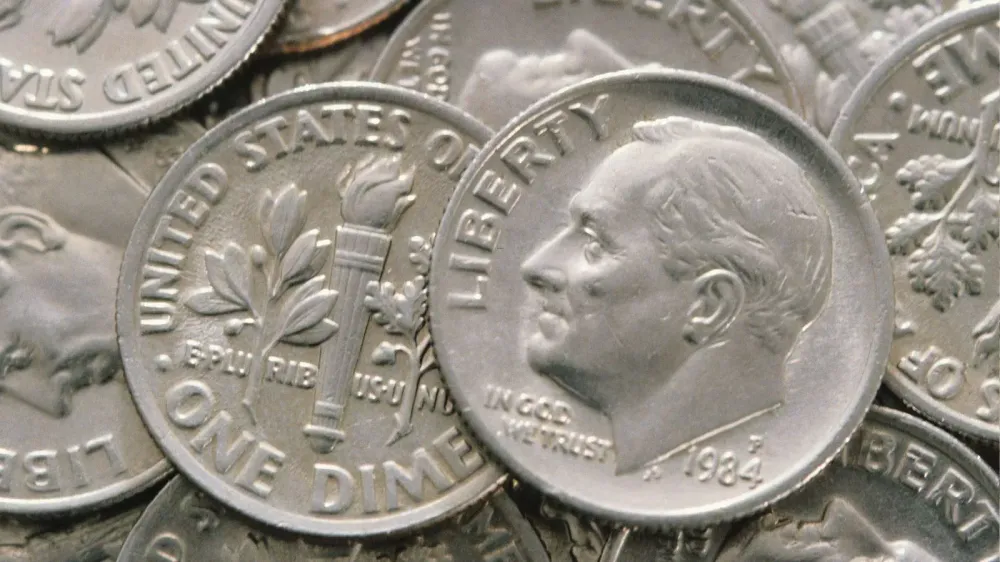
Designed by John Sinnock to honor President Franklin D. Roosevelt, who died in 1945. The obverse depicts Roosevelt in profile; the reverse shows a torch flanked by an olive branch and oak branch. Roosevelt dimes were struck in 90% silver through 1964, then switched to copper-nickel clad in 1965. Most Roosevelt dimes are common and worth face value or silver melt. The exceptions — No-S proof errors, the 1996-W West Point issue, and condition rarities with Full Torch designation — can reach hundreds of thousands of dollars.
The Rare Dimes List — Key Dates Every Collector Should Know
This isn't an exhaustive catalog of every dime ever struck across six series and 230 years. It's the list that actually matters — the coins where the value difference between knowing and not knowing is measured in real money.
1873-CC Seated Liberty Dime (No Arrows)
Estimated Value: $3,600,000 · The only known example — the most valuable dime ever sold
This is not a coin you will find in a coin roll or an estate collection. It is mentioned here because it defines the ceiling of the dime market and because understanding how a single surviving example comes to exist — and what it sells for — changes how you think about rarity in this category. In 1873, the Carson City Mint struck 12,400 Seated Liberty dimes before the Coinage Act ordered all old-style dimes melted and recoined. Every example was destroyed except one, which survived because it was set aside in the Assay Commission's testing batch.
That single surviving coin — graded MS65 by PCGS with a perfect R-10.0 rarity rating — sold at Heritage Auctions in January 2023 for $3,600,000. This was nearly double its previous $1.84 million record from 2012. A die crack through the mint mark makes it visually identifiable. There is no second example. There will not be one.
1894-S Barber Dime
Estimated Value: $1,320,000 – $1,997,500 · Only 9 of the original 24 known to survive
The 1894-S Barber Dime is the coin that defines the Barber series — and one of the most mysterious coins in American numismatic history. Only 24 were struck at the San Francisco Mint in 1894, all as proof coins. Why? The circumstances remain disputed. Leading theories suggest they were struck either to balance the mint's books at year-end or as special presentation pieces for mint officials and their associates. One story holds that San Francisco Mint Superintendent John Daggett gave three to his daughter, who reportedly spent one on an ice cream cone.
Of the 24 originally minted, only 9 are confirmed to exist today. The finest known example — graded Proof 66 by PCGS — sold at Heritage Auctions in January 2016 for $1,997,500. In August 2019, another example sold at Stack's Bowers for $1,320,000. Each time one surfaces at auction, it is treated as a numismatic event. If you think you have one, authentication by PCGS or NGC is not optional — it is the only thing that makes the coin sellable at its actual value.
1975 No-S Proof Roosevelt Dime
Estimated Value: $456,000 – $506,000 · Only 2 confirmed examples in existence
The 1975 No-S is the coin that proves modern coins can generate historic money. Beginning in 1968, proof dies for all denominations were prepared at the Philadelphia Mint before being shipped to San Francisco for striking. During this process for the 1975 proof dime, the San Francisco mint mark was accidentally omitted from one die — producing proof coins without the 'S' that all legitimate 1975 proof dimes should carry.
Only two confirmed examples exist. A California collector discovered both in 1977 after ordering five proof sets from the Mint — an extraordinary story that underlines how unexpected the find was. The finest known, graded PR68 by PCGS, sold at Heritage Auctions in September 2019 for $456,000. To identify a genuine 1975 No-S, look for proof characteristics — mirror-like surfaces, sharp strike — but no 'S' mint mark below the date. Every legitimate 1975 proof dime has the 'S'. The absence of it is the whole story.
1916-D Mercury Dime
Estimated Value: $650+ (heavily worn) to $200,000+ (MS67) · The 'King' of the Mercury series
The 1916-D is the coin that anchors every Mercury Dime collection. The Denver Mint struck just 264,000 — a very small mintage even by the standards of a year when coin production was still measured in the millions. As the first year of the beloved Mercury design, collector demand was immediate, and the D-mint issue was recognized as scarce almost from the start.
Even heavily worn examples with dates barely legible sell for hundreds of dollars. A coin in Good condition is worth $650 or more. In Mint State, values escalate dramatically — a high-grade MS67 has cleared $200,000 at auction. The Full Bands premium applies here too: a 1916-D with Full Bands designation in top grades represents the intersection of the series' most important key date with its most demanding condition standard. Look for the 'D' mint mark on the reverse, along the lower rim near the bottom of the fasces.
1968 No-S Proof Roosevelt Dime
Estimated Value: $20,000 – $50,000+ depending on grade · Famous modern proof error
Like the 1975 No-S, the 1968 No-S Proof Roosevelt Dime resulted from the process of preparing proof dies at Philadelphia before shipping to San Francisco. The mint mark was left off one die. Unlike the 1975 version, the 1968 No-S is slightly less rare — though still genuinely scarce and worth tens of thousands of dollars for confirmed examples.
Authentication by PCGS or NGC is mandatory. The distinguishing characteristic is identical to the 1975 version: proof surfaces (mirror-like fields, frosted devices) without any 'S' mint mark below the date. All legitimate 1968 proof dimes carry the 'S'. Its absence makes an ordinary proof into a significant rarity.
1942/1 Mercury Dime Overdate
Estimated Value: $400 – $2,500+ · The most dramatic error in the Mercury series
Overdate errors occur when a die from a previous year is reused, with the new year punched over the old. In 1942, some 1941 dies were modified and put back into service — creating Mercury Dimes where both the '2' and the '1' are visible in the date when examined under magnification. The 1942/1 exists in both Philadelphia (no mint mark) and Denver (D) versions; the Denver variety is rarer.
Circulated examples typically sell for $400–$500, which makes this one of the more accessible valuable errors in the Mercury series. Uncirculated examples are considerably scarcer — high-grade specimens can exceed $2,500, and the premium climbs steeply with a Full Bands designation on top. The overdate is visible under a 5x loupe: look for the remnants of the '1' beneath the '2' in the date.
1921 and 1921-D Mercury Dimes
Estimated Value: $48 – $2,000+ · Semi-key dates from a critical production year
In 1921, the U.S. Mint's priorities shifted dramatically. The Pittman Act required the melting and recoinage of silver dollars, which consumed production capacity at every facility. Dime output dropped sharply. The Philadelphia issue had a mintage of just over 1 million; the Denver issue — the 1921-D — was even lower, making it the second rarest date in the Mercury series after the 1916-D.
Circulated examples of the 1921 and 1921-D are worth $48–$178 depending on grade and mint mark — meaningfully more than silver melt value, but still accessible for beginning collectors. In uncirculated grades, the premium grows. These are coins that show up in old collections and album sets with enough regularity to be findable, which is more than can be said for the 1916-D or the 1894-S Barber.
1938-S Mercury Dime (Full Bands)
Estimated Value: $50 (no FB) to $364,250 (MS68+ FB) · The condition rarity that proves Full Bands matters
The 1938-S Mercury Dime is not a key date by mintage. It is a condition rarity — a coin where the challenge is not finding one, but finding one in a grade where the Full Bands designation can be applied. The 1938-S with Full Bands in MS68+ has sold for $364,250 at auction. Without the Full Bands designation, the same coin in the same grade might bring $50.
This is the most extreme example of the Full Bands premium in the Mercury series, and it's the coin that numismatists cite when explaining why Full Bands matters as much as key dates. The horizontal bands on the fasces on the reverse must be complete and fully separated — a standard that most 1938-S coins do not meet due to the strike characteristics of the San Francisco Mint that year.
1982 No-P Roosevelt Dime
Estimated Value: $65 – $175 · The only valuable Roosevelt dime you can still find in circulation
The 1982 No-P is the most accessible valuable dime for most collectors — the one that still turns up in coin rolls and pocket change with enough frequency to make searching worthwhile. At the Philadelphia Mint, certain dimes dated 1982 were struck using obverse dies that had not received the 'P' mint mark before production. Those coins entered circulation.
In average circulated condition, a confirmed 1982 No-P sells for approximately $65. Uncirculated examples reach $175. These are not life-changing numbers, but they are real premiums on a coin that looks like ordinary pocket change — and that's the point. The way to find it: examine 1982 Philadelphia dimes (no mint mark on common pre-1980 coins, 'P' added in 1980) under magnification. The missing 'P' is the whole story.
1996-W Roosevelt Dime
Estimated Value: $10 – $30 · The only non-bullion coin ever struck at West Point
The 1996-W Roosevelt Dime occupies a unique place in American coinage history: it is the only non-bullion coin ever issued at the West Point Mint facility. Struck to mark the 50th anniversary of the Roosevelt dime design, it was included exclusively in 1996 uncirculated mint sets — not available through any other channel.
Mintage was 1,457,000, which sounds substantial but is modest by modern standards. Because the coin was only ever distributed in mint sets, examples in pristine condition are relatively common; circulated examples are rare. Value ranges from $10 to $30 for most examples, but the coin's historical distinction as a West Point exclusive makes it a desirable addition to any Roosevelt dime collection.
1895-O Barber Dime
Estimated Value: $100 – $5,000+ · The most difficult Barber key date below the 1894-S
Below the supreme rarity of the 1894-S, the 1895-O from the New Orleans Mint is the Barber series key date that challenges collectors building complete sets. Mintage was just 440,000 — a very low number for a circulation coin — and most examples entered heavy use immediately, surviving in lower grades. Finding a 1895-O in Fine or better condition is genuinely difficult; finding one in Mint State is exceptional.
The 1901-S San Francisco issue is similarly challenging in higher grades, as is the 1896-O. These are not million-dollar coins, but they represent the authentic collecting challenge in the Barber series for collectors who cannot reach the 1894-S: assembling a complete set in consistent grade across all the semi-key dates.
1846 Seated Liberty Dime
Estimated Value: $500 – $50,000+ · Lowest mintage in the Seated Liberty series
The 1846 Seated Liberty Dime had a mintage of just 31,300 — one of the lowest for any circulation-strike Seated Liberty dime. Most examples entered immediate circulation and suffered heavy wear; survivors in higher grades are genuinely scarce. The coin is a key date for collectors pursuing the Seated Liberty series in circulated grades, and a significant rarity in Mint State.
Other key Seated Liberty dates worth noting include the 1843-O (New Orleans, 150,000 mintage), the 1858-S (San Francisco, 60,000), and the 1844 — sometimes called the 'Little Orphan Annie' dime for its very low mintage of 72,500 and the challenge it poses for set collectors. Any Seated Liberty dime in consistent quality above Fine deserves a closer look at date and mint mark.
Dimes Worth Money by Series — What to Look For
Valuable dimes cluster around specific circumstances in each series. Here is what actually matters, series by series, for a collector working through old coins.
Draped Bust & Capped Bust Dimes (1796–1837)
The earliest American dimes. Most examples that survive are worn from decades of hard use. Any example in Fine or better condition is worth significant money simply for age and scarcity. Key dates are defined by extremely low mintages in a period when total U.S. coin production was measured in hundreds of thousands rather than millions.
- 1796 & 1797 Draped Bust — First American dimes. High-grade examples reach $800,000. Scarce in all grades.
- 1804 Draped Bust — Exists in two varieties (13-star and 14-star reverse). Top-grade examples have sold for over $600,000.
- 1822 Capped Bust — Proof-only rarity. Approximately two known. One of the rarest coins in the Capped Bust series.
- 1829 Curl Base 2 Capped Bust — Popular variety with a unique style of '2' in the date. Commands a premium over regular 1829 issues.
Seated Liberty Dimes (1837–1891)
The longest-running dime design contains the most valuable individual dime ever sold. Outside that singular outlier, the series is defined by Carson City (CC) mint issues — which are scarce across all dates — and a handful of extremely low-mintage Philadelphia and branch mint issues from the 1840s–1870s.
- 1873-CC No Arrows — Unique. Only example sold for $3.6 million in 2023. Not findable; worth knowing exists.
- 1871-CC, 1872-CC, 1874-CC — All Carson City issues from this era are scarce. Premium in all grades.
- 1846 — Mintage of 31,300. Key low-mintage date across the series.
- 1844 ('Little Orphan Annie') — Mintage of 72,500. Strong collector demand makes it harder to find than mintage alone suggests.
- 1856-S — First San Francisco Mint dime. Low mintage and strong demand in higher grades.
- Any S or CC mint mark from the 1860s–1870s — Worth checking date and grade before assuming common.
Barber Dimes (1892–1916)
A series with one supreme rarity that dwarfs everything below it. Below the 1894-S, the series has a handful of genuine semi-key dates but is otherwise accessible — common circulated examples are worth $10–$50 in silver. The key is knowing which dates command premiums and which do not.
- 1894-S — Only 24 minted. 9 known to survive. $1–$2 million each. Authentication mandatory.
- 1895-O — Mintage of 440,000 from New Orleans. Most difficult Barber key date below the 1894-S.
- 1901-S — Significant condition rarity. Uncirculated examples command substantial premiums.
- 1896-O — Scarce, particularly in Mint State.
- 1892-S — First San Francisco Barber dime. Premium over common dates.
- Any S mint mark — San Francisco produced fewer Barber dimes than Philadelphia, and key dates cluster there.
Mercury Dimes (1916–1945)
The most popular series among modern dime collectors. The Full Bands designation creates two parallel markets within the series — coins with it and coins without — and the premium can be ten to one hundred times the base value. Sort by date and mint mark first; assess strike and Full Bands potential second.
- 1916-D — The 'King.' Mintage of 264,000. $650+ in worn grades; $200,000+ in top Mint State. Look for 'D' below the fasces on the reverse.
- 1921 & 1921-D — Semi-key dates from a low-production year. Both worth well above silver melt.
- 1942/1 Overdate (P and D) — '1' visible beneath '2' under magnification. $400–$2,500+ depending on grade and Full Bands.
- 1926-S — Lower mintage San Francisco issue. Semi-key date in all grades.
- 1931-D & 1931-S — Depression-era low mintages. Worth premium above silver melt.
- 1938-S Full Bands — Condition rarity. Up to $364,250 in top Full Bands grade. Proves that common dates in rare condition rival key dates entirely.
- 1945 Full Bands — Another condition rarity at the top of the grade range.
- Any Full Bands designation on any date — Can multiply value ten to one hundred times. Always assess the fasces bands under magnification.
Roosevelt Dimes (1946–1964) — Silver Era
Roosevelt dimes from 1946 through 1964 are 90% silver and worth at least $1.50–$2.00 each at current silver prices. Most are common. The key dates in the silver era are genuinely scarce in top grades, and the Full Torch designation for Roosevelt dimes mirrors the Full Bands premium for Mercury dimes.
- All 1946–1964 Roosevelt dimes — Worth at minimum silver melt value. Worth separating from clad examples.
- 1949-S — One of the lowest-mintage circulation issues in the series. Key date in higher grades.
- 1950-S — Similarly low San Francisco mintage. Premium in uncirculated condition.
- 1955 — Lower Philadelphia mintage than surrounding years. Semi-key date.
- Full Torch designation on any silver date — Significantly increases value in uncirculated grades.
Roosevelt Dimes (1965–Present) — Clad Era
Clad Roosevelt dimes are common. The exceptions are proof errors — where the San Francisco mint mark was accidentally omitted — the 1996-W West Point exclusive, and condition rarities in top census grades. For most clad Roosevelt dimes, face value is the realistic expectation.
- 1968 No-S Proof — Missing San Francisco mint mark on proof coin. Worth $20,000–$50,000+.
- 1970 No-S Proof — Similar error. Scarce and valuable.
- 1975 No-S Proof — Only 2 known. $456,000 for the finest. The most valuable modern dime.
- 1982 No-P — Missing Philadelphia mint mark on circulation coin. $65–$175. Still occasionally found in pocket change.
- 1983 No-S Proof — Additional missing mint mark proof error. Scarce and collectible.
- 1996-W — West Point Mint exclusive. Only in 1996 uncirculated sets. $10–$30.
Silver Dimes Worth Money — The Special Case
Pre-1965 dimes deserve their own section because they represent the most accessible valuable coin category for most people — and also the one most frequently overlooked. Here's the situation in full.
Every dime struck before 1965 — Draped Bust through Roosevelt — contains 90% silver and 10% copper. Each one holds approximately 0.0723 troy ounces of silver. At current silver prices around $30 per ounce, that's roughly $2.17 per coin in metal value alone. That's more than twenty times face value, for a coin that looks like ordinary change.
Here's how to think about silver dime values in practice:
- Common circulated silver dimes (any date, all series) — Worth approximately $1.50–$2.17 in silver content. Worth separating from clad dimes in any collection or inherited jar of coins. Not life-changing money individually, but meaningful at scale.
- Uncirculated silver dimes with original luster — Worth $5–$100+ depending on date, mint mark, and series. The silver era Roosevelt dimes (1946–1964) in uncirculated condition with strong strikes are particularly sought after by type collectors.
- Key date silver dimes in any grade — The premiums discussed throughout this guide — from the 1916-D Mercury to the 1894-S Barber — sit on top of the silver baseline. The silver value is the floor. Rarity and condition build upward from there.
- Full Bands / Full Torch designation on silver dimes — On Mercury Dimes, fully separated horizontal bands on the fasces reverse. On Roosevelt Dimes, sharp torch details. Either designation can multiply a coin's value ten to one hundred times in identical grade. Always check under magnification.
One practical note: pre-1965 silver dimes have a slightly different appearance and sound than clad dimes — the silver composition gives them a warmer color and a more musical ring when dropped. Once you've made the comparison directly, silver dimes are identifiable by eye and ear in most cases. The date is the final confirmation.
How to Know What Your Dime Is Actually Worth
The gap between what people think their old dimes are worth and what they're actually worth usually comes down to three things: series identification, the silver content baseline, and the Full Bands or Full Torch designation that most collectors miss entirely. Here's the practical process:
- Check the date first — 1964 or earlier means silver. That's your baseline: roughly $2 in metal value regardless of anything else. From there, identify the series — Roosevelt, Mercury, Barber, Seated Liberty, Capped Bust, or Draped Bust — and cross-reference against the key dates in that series.
- Check the mint mark — Location varies by series. On Barber and Roosevelt dimes, the mint mark is on the reverse below the wreath or torch. On Mercury dimes, it's on the reverse near the fasces. On Seated Liberty dimes, it's on the reverse below the eagle or wreath. San Francisco (S) and Carson City (CC) mint marks consistently command premiums over Philadelphia issues in virtually every series.
- Examine the Full Bands or Full Torch under magnification — For Mercury Dimes: look at the horizontal bands on the fasces on the reverse. Two complete, fully separated bands on both the upper and lower tie indicate Full Bands. For Roosevelt Dimes: examine the torch details on the reverse for complete, unbroken separation of the vertical lines. A 5x loupe is sufficient for initial assessment.
- Use a coin identifier app for initial assessment — Apps like CoinHix cover 300,000+ U.S. coin types and grade within 2–3 points on the Sheldon Scale. CoinKnow distinguishes between copper color grades and Proof finish designations. Both flag error varieties automatically — which matters for dimes where No-S proof errors are worth tens of thousands of dollars.
- Cross-reference with real auction data — PCGS CoinFacts is free and covers 39,000+ U.S. coins with 3.2 million auction records across Heritage, Sotheby's, Stack's Bowers, and eBay. It's where you verify what a coin actually cleared at auction — not what a price guide estimated years ago.
- Get professional authentication for anything significant — If research suggests a coin might be worth more than $100, PCGS or NGC grading is not optional. For coins like the 1894-S Barber, the 1916-D Mercury, or any No-S proof error, third-party certification is the only thing that makes a coin fully saleable at its actual value.
Dime collecting spans 230 years of American history and six distinct designs. The most valuable dimes are genuinely extraordinary objects — unique survivals, intentional rarities, and manufacturing accidents that slipped through quality control. But the accessible ones are also genuinely valuable: every pre-1965 dime is worth more than face value, and every serious collection of Mercury or Barber dimes contains real money hiding behind the question of what the fasces bands look like under a loupe. Knowing what to look for — and having the tools to catch what you'd otherwise miss — is where this starts.